01Partition
Group candidate tokens
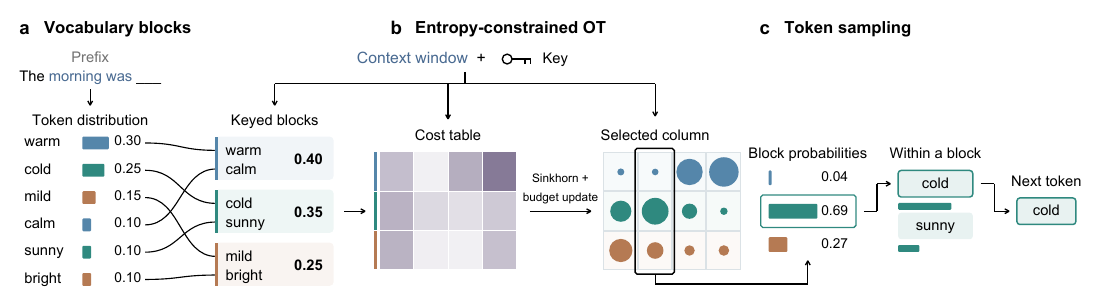
A secret key and preceding context divide the vocabulary into blocks. A token is a word or part of one.
OpenAI’s textGrain embeds an invisible statistical signal in word choices during generation. A detector checks for that signal to identify an OpenAI watermark.
◎ An independent guide to the technology
Is an OpenAI watermark detected?
01 / THE CORE IDEA
To understand the technology, start with two separate actions: embedding and detection.
textGrain checks for a deliberately embedded watermark, rather than judging writing style. Its scope is an OpenAI watermark, not every kind of AI-generated text.
Follow the signal02 / HOW IT WORKS
Three steps to follow.
One technical report to go deeper.
A secret key and preceding context divide the vocabulary into blocks. A token is a word or part of one.
Optimal transport selects blocks under an entropy-loss budget. Within each block, relative token probabilities stay unchanged.
Text and the key reconstruct the statistical signal. Detection does not require the generation-time entropy budget.
Technical reference: textGrain: Entropy-Calibrated Watermarking for Language Model Text ↗
03 / MEASURED PERFORMANCE
Psychology-like content · target false-positive rate: 1%
Math content had substantially lower detection rates.
Separate evaluation · 400-token English passages
Different experiments: the baseline rates are not interchangeable.
Charts redrawn from OpenAI’s October 5, 2026 evaluations. These detection rates are not a guarantee of real-world accuracy.
A watermark does not establish truth, human contribution, ownership, or responsibility.
No detected watermark does not prove human authorship.
The signal does not identify accounts, prompts, or conversations.
05 / AVAILABILITY
Launch plans as of October 5, 2026.
Check the official source for updates.
Select models; watermarking is off by default.
Eligible text outputs over the coming weeks.
Initially researchers and expert organizations, not the general public.
Open sourcing is planned, not confirmed as released. Read the announcement ↗
06 / QUESTIONS, ANSWERED
Start with the question that brought you here.
textGrain is OpenAI’s technology name. This independent guide uses “text grain” as its title to help readers find and understand it.
OpenAI reports no meaningful differences in its published Astra benchmarks. That does not guarantee identical quality in every setting.
Use the official article and technical report links on this page. Our guide was reviewed on October 6, 2026; consult the original sources for later updates.
This site is an illustrated guide, not a detector. It does not collect or upload your text. See the official article for detector access information.
START WITH THE SOURCE
Take the next step with OpenAI’s original article and technical report.